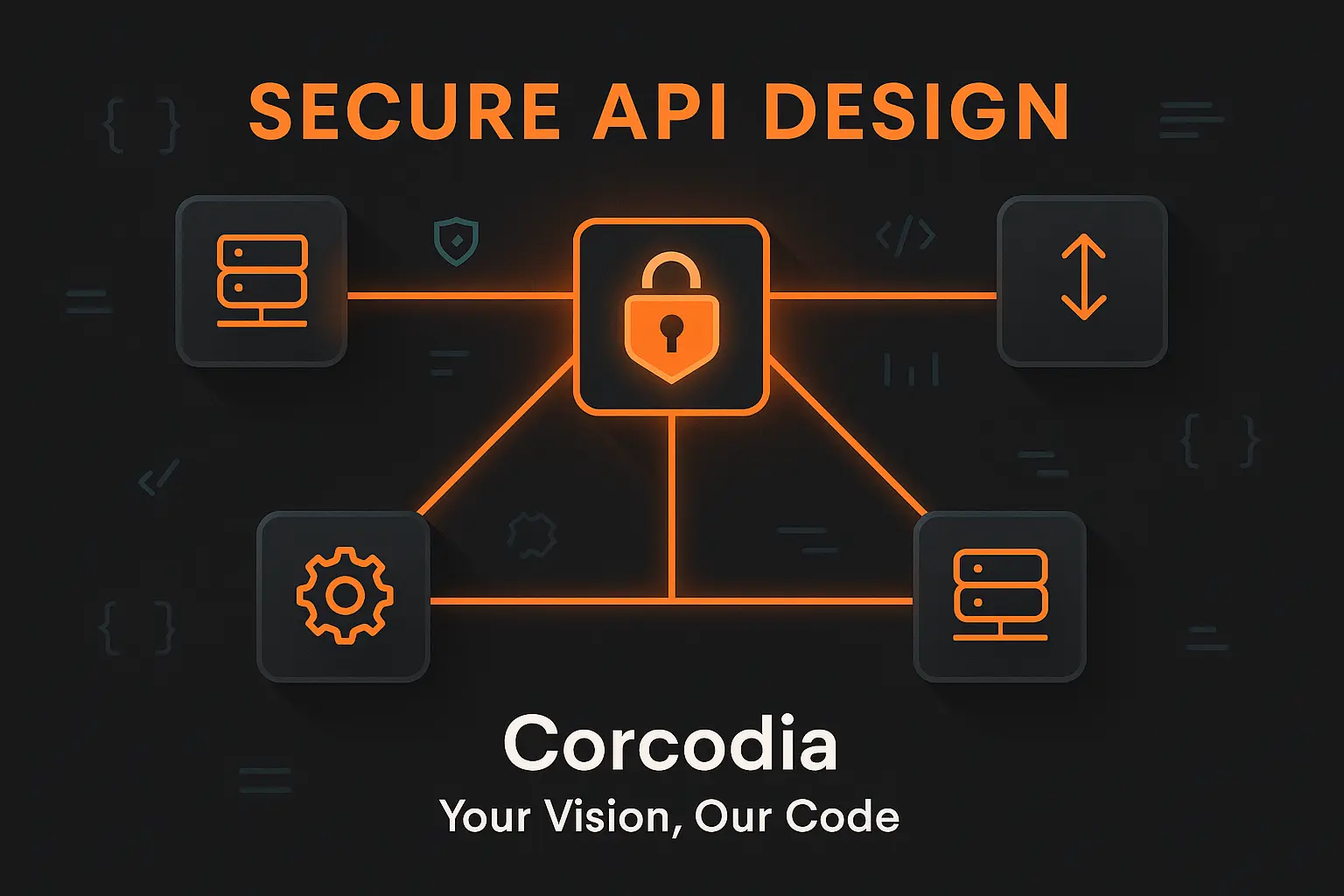
An API is more than an interface. It’s an agreement: we send data, we get data, we trust that it’s safe, consistent and available.
In modern systems - mobile apps, partner integrations, internal microservices - that trust is everything.
At Corcodia, we design APIs as products, not just endpoints. That means performance, clarity… and security by default.
The first rule: know who is calling you and what they’re allowed to do.
- Authentication confirms identity (Who are you?).
- Authorization confirms permission (What are you allowed to touch?).
Modern API security patterns include:
- OAuth2 / OpenID Connect for user-facing flows
- Service-to-service tokens (JWT with short TTL) for internal communication
- Role-based and scope-based access to limit exposure
Takeaway: never expose more than the caller should see.
APIs move valuable data. That data must be protected everywhere.
Key practices:
- TLS everywhere. No plain HTTP. Ever.
- Field-level protection. Sensitive fields (PII, health, billing) should be encrypted or masked.
- No secrets in logs. Logs are not safe storage.
Good API design assumes one truth: anything not explicitly protected is potentially leaked.
Takeaway: encryption is not a feature - it’s table stakes.
Untrusted input is the #1 attack surface.
Secure APIs must:
- Strictly validate types, ranges, formats
- Reject what’s unexpected
- Throttle abuse with rate limits, quotas and IP rules
This is not just for security - it’s for reliability.
When one bad client can’t flood you, everyone else stays stable.
Takeaway: safety and uptime are the same fight.
A secure API isn’t just about “no breach.”
It’s about predictable behavior over time.
Mature APIs:
- Are versioned (v1, v2…) to avoid silent breaking changes
- Are observable (audit logs, metrics, traceability)
- Fail gracefully with meaningful error codes instead of raw stack traces
Security is not only blocking attackers. It’s also protecting honest clients from chaos.
Takeaway: predictable APIs build trust - with partners, with clients, with your own team.
Conclusion
Secure API design is not an afterthought - it’s architecture.
When you build with access control, data protection, controlled input and predictable evolution, you’re not just shipping endpoints.
You’re creating an integration surface your product can safely scale on.
At Corcodia, we design APIs that teams can depend on - today and in production at scale.
Your Vision, Our Code.